Product Details
- Home
- CHINA – MYSTIQUE AND INTRIGUE: ECHOES OF AN EMPIRE™

CHINA – MYSTIQUE AND INTRIGUE: ECHOES OF AN EMPIRE™1 DayFLEXIBLE DATES
$530 – $1,400Price range: $530 through $1,400
The price shown is per person, not per room. Use the quantity selector to choose the number of travelers and see your total price.
OVERVIEW
For centuries, Beijing was more than the seat of China’s emperors. It was a capital shaped around an idea of order. Gates controlled movement, courtyards reflected hierarchy, ceremonies reinforced authority, and an extraordinary north-south axis placed imperial power at the symbolic heart of the city. Yet beyond the crimson walls lived another Beijing: families, scholars, merchants, cooks, craftspeople, officials, and generations of people whose everyday lives unfolded around the world of the court.
ECHOES OF AN EMPIRE: BEIJING enters both sides of this historical city. Discover how architecture communicated power, how ritual and ideas of harmony shaped the imperial world, and how food, family life, neighborhoods, and traditions connected the palace to the city beyond its gates. Along the way, even the Chinese characters written across Beijing begin to reveal another layer of meaning. By night, the walls, courtyards, rooftops, lanes, and waterways no longer appear as separate pieces of old Beijing. They belong to a city once organized around an emperor, but sustained, inhabited, and ultimately inherited by everyone beyond his throne.
ITINERARY
BEIJING
Chapter I: Before the Gates
Before the emperor’s gates open, another Beijing is already awake.
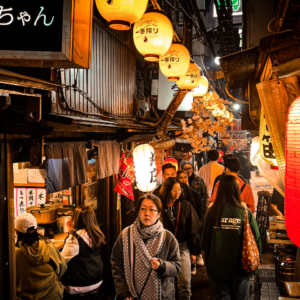
Begin among the historic lanes of Beijing as breakfast shops fill with conversation and the morning begins unfolding behind grey-brick walls. Settle somewhere local for a traditional Beijing breakfast and tea, experiencing the city at its most ordinary before encountering it at its most monumental. Around you is the world beyond the palace: neighborhoods where families lived, merchants traded, craftsmen worked, officials maintained households, and generations built their lives around an imperial capital. There is no need to understand everything yet. The walls and rooftops waiting beyond the neighborhood will soon tell a very different story. For now, Beijing belongs to the people waking beneath them.
Chapter II: The Center of the World
In imperial Beijing, power did not need to announce itself. The city had already been arranged around it.
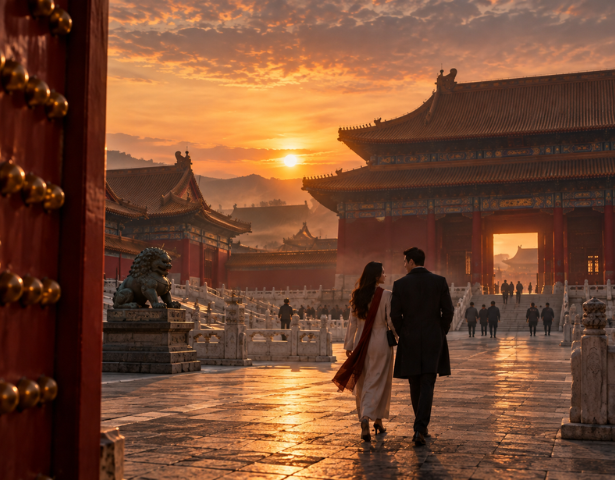
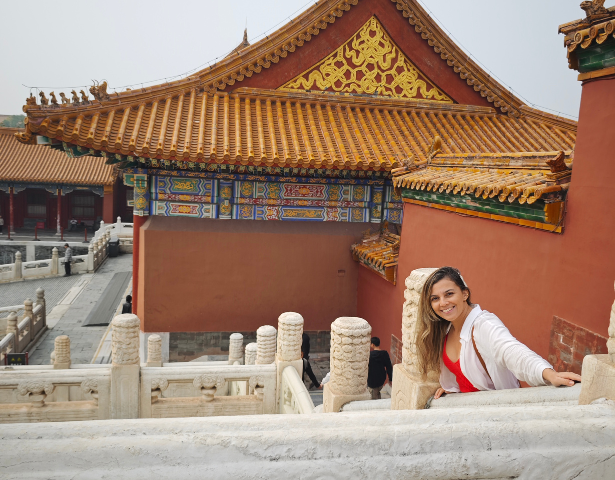
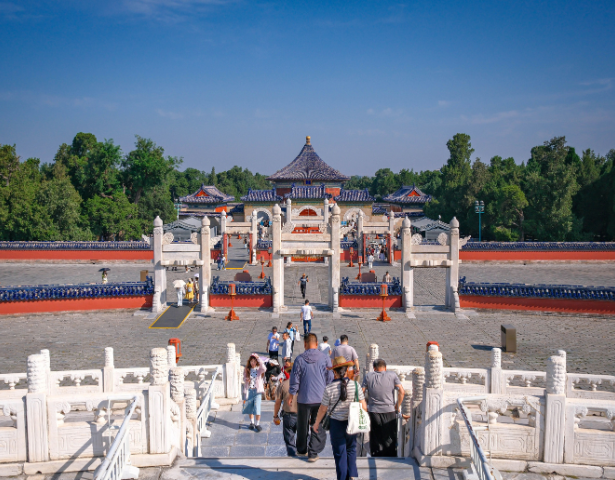
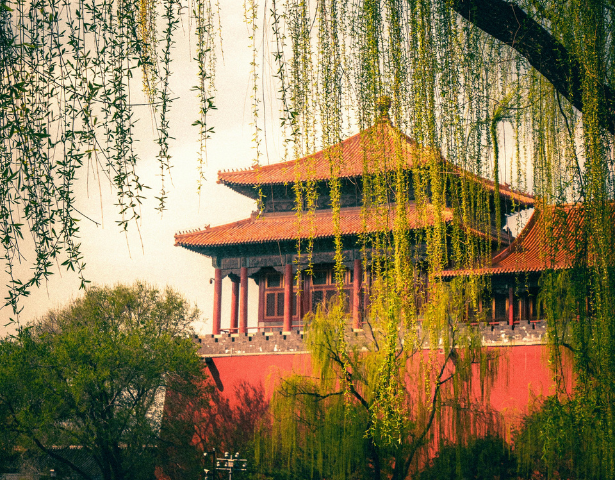
Follow Beijing’s historic Central Axis toward the Forbidden City, passing through gates and immense ceremonial spaces as the human scale of the morning disappears behind you. Rather than collecting famous halls, learn to read the palace itself: symmetry and hierarchy, outer court and inner world, ceremony and privacy, Heaven and Earth, and the carefully controlled movement toward the emperor at its center. Look more closely at selected characters written above gates and halls as your N.I.T.E. Insider reveals how their meanings add another layer to the spaces around you. Architecture, ritual, language, and belief begin telling the same story. The Forbidden City is spectacular because of its scale. It becomes far more fascinating once you realize how little of that scale was accidental.
Chapter III: At the Imperial Table
Leave the ceremonial halls behind. Another expression of the capital is waiting at the table.
Settle into an elegant historical or traditional setting for a refined Beijing lunch centered around one of the city’s most celebrated culinary traditions: Peking duck. Watch as the crisp-skinned bird arrives and is carefully carved before exploring the accompaniments, techniques, and flavors that have made it part of Beijing’s culinary identity. Its story reaches beyond a single emperor or palace kitchen. Court traditions, regional influences, skilled cooks, restaurants, and generations of changing urban tastes all contributed to the food culture of the capital. This morning, breakfast belonged to the neighborhood. Now the table reveals another Beijing: sophisticated, meticulous, and shaped by the demands and opportunities of a city built around power.
Chapter IV: Beyond the Red Walls
The palace disappears behind you. Beijing becomes smaller again, and the people return to the story.
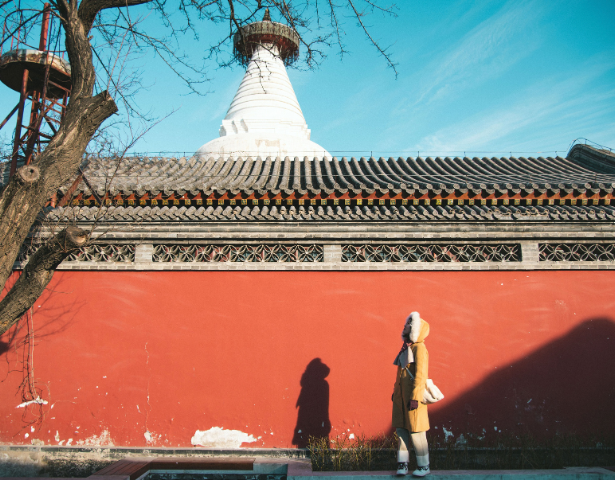
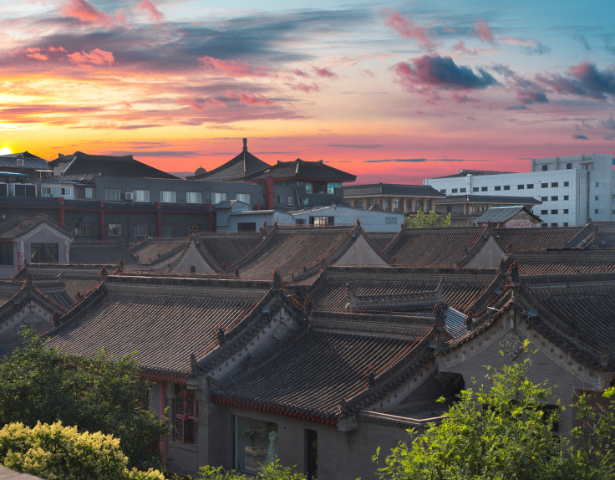
Move north into the historic neighborhoods beyond the imperial walls, where monumental courtyards give way to narrow hutongs, neighborhood temples, shops, old residences, and the everyday spaces of the city. Walk rather than rush, noticing how dramatically the scale has changed since the morning. Here, history is less about emperors and ceremonies and more about the people who inhabited the capital around them. Officials returned to households. Merchants opened businesses. Craftspeople worked behind modest doors. Families shared lanes and courtyards across generations. The imperial city depended upon a much larger human world beyond its gates. This afternoon, that world is no longer simply the background to Beijing’s history. It becomes the story itself.
Chapter V: Behind the Courtyard Door
From the street, a grey wall reveals almost nothing. Step through its doorway, and an entire world turns inward.
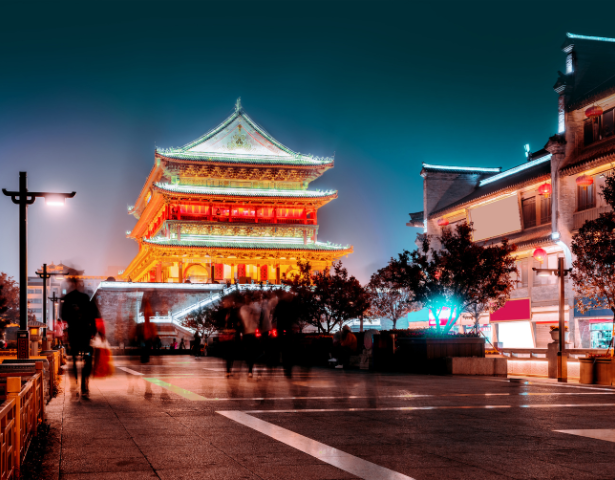
Enter a traditional siheyuan courtyard and discover another system of space, this time built around family rather than emperor. Rooms, orientation, generations, privacy, and shared courtyards reveal how domestic life could be organized behind the walls of old Beijing. Continue toward the Drum and Bell Towers, whose presence recalls how the historical capital once organized not only space, but time itself. As daylight fades over the surrounding hutongs, settle around a relaxed Beijing table for dinner. After the scale and ceremony of the Forbidden City, these smaller spaces offer a different kind of history: homes, neighborhoods, meals, routines, and relationships. Empires are remembered through monuments. Cities survive through the people living between them.
Chapter VI: The City Revealed
The palace gates are closed behind you. One final message is waiting.
As dinner comes to an end, a sealed letter arrives at the table. Inside is a clue leading deeper into old Beijing as daylight gives way to the city after dark. Follow it toward Shichahai and step aboard a boat, leaving the hutongs behind as lights shimmer across the historic waterways. After a day defined by walls, gates, courtyards, and carefully ordered spaces, Beijing suddenly opens across the water. When you return to shore, one final clue leads through the lanes toward an understated door and a final drink in an intimate setting. This morning, Beijing seemed like a maze. Now the palace, neighborhood, courtyard, table, and water belong to the same story. The emperors are gone. Their city has changed beyond recognition. Yet once you know how to read it, their echoes remain everywhere.
OVERVIEW
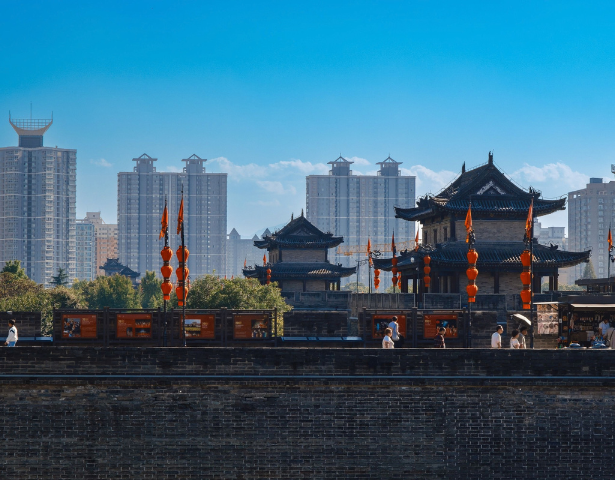
More than a thousand years ago, Chang’an stood at the heart of one of China’s most extraordinary eras. Capital of the Tang Dynasty and a great eastern center of the Silk Roads, it was a city where merchants, diplomats, monks, artists, musicians, travelers, and ideas arrived from across Asia and beyond. Goods changed hands, religions traveled, unfamiliar sounds entered the court, new tastes appeared at the table, and influences from distant cultures became part of the rhythm of life in the capital.
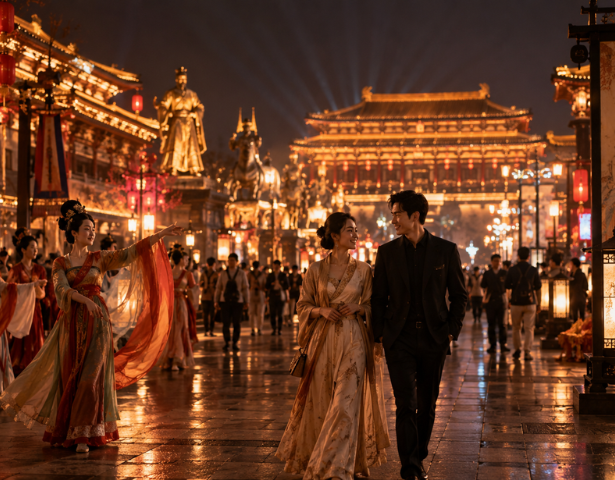
ECHOES OF AN EMPIRE: XI’AN follows what happened when that world reached Chang’an. Discover a city that did more than receive what arrived. It absorbed, interpreted, and transformed it. Follow the movement of belief and knowledge across continents, taste a culinary identity shaped by generations of exchange, and discover how the people and cultures moving through Chang’an found their way into the things it created. As night falls, the ancient capital returns in an entirely different form, through the imagination of modern Xi’an itself. The Tang Empire disappeared centuries ago, yet the city it created still remembers a time when roads from distant worlds converged here, and Chang’an made something of its own from what they carried.
ITINERARY
XI’AN
Chapter I: Before the Roads Meet
Before Chang’an could welcome the world, there had to be a city waiting for it.
Begin over a local Xi’an breakfast as the modern city wakes around you. Settle somewhere unassuming and distinctly local, sharing the foods and morning rhythms of a city whose history stretches far beyond the Tang Dynasty. Beneath today’s Xi’an once stood Chang’an, a vast imperial capital that would become one of the great meeting places of its age. During the Tang, people, goods, beliefs, languages, music, fashions, and ideas moved toward this city from across an enormous network of routes. But before following any of them, begin with the place itself. Eat, look around, and meet Xi’an at a human scale. Soon, the roads begin to converge.
Chapter II: Where the World Arrived
The Silk Roads were never a single road. Here, countless journeys became a city.
Begin where Chang’an’s Western Market once stood, one of the great commercial meeting places of the Tang capital. Explore selected archaeological remains and objects that reveal the movement of merchants, goods, currencies, languages, and cultures through the city. Then step from the traces of the ancient market into today’s 大唐西市, a modern commercial and cultural district shaped around this historic site. Browse among shops and traders, speak with local sellers where opportunities arise, and experience the simple human rituals of a marketplace: looking, asking, choosing, negotiating, and exchanging. More than a thousand years apart, commerce continues to bring strangers together here.
Chapter III: The Journey East
Not everything that traveled the Silk Roads could be carried in a merchant’s hands.
Continue to the Giant Wild Goose Pagoda and follow the extraordinary story of Xuanzang, the Chinese Buddhist monk who left Chang’an and journeyed across Central Asia to India in search of Buddhist knowledge. Years later, he returned carrying texts and ideas that became part of an enormous translation effort in the Tang capital. As you explore the temple complex, look more closely at the Chinese writing around you. Through a carefully selected inscription, plaque, stele, or character encountered along the way, your N.I.T.E. Insider reveals how meaning moves between languages as well as places. The pagoda recalls an age when belief and knowledge crossed borders, entered new languages, and became part of new cultural worlds.
Chapter IV: At the Same Table
Eventually, journeys across mountains and deserts found their way to the table.
Settle in for lunch and explore Xi’an through one of the most immediate traces of centuries of movement: food. Taste a carefully selected menu rooted in the culinary identity of Xi’an and the wider region while your N.I.T.E. Insider reveals the stories behind particular ingredients, flavors, techniques, and traditions. Some connections reach outward through trade and migration; others belong to communities and generations who made this city their home. By the time food reaches a table, origins are rarely simple. Recipes change, tastes adapt, and what once seemed unfamiliar can eventually become inseparable from a place. In Xi’an, history is not only something you see. Sometimes, you eat it.
Chapter V: When Worlds Took Form
The people and cultures moving through Chang’an did not disappear when the journey ended. Their presence found its way into the things the Tang created.
Spend time with a local practitioner and enter the colorful world of Tang Sancai, the distinctive glazed ceramics associated with one of China’s most cosmopolitan eras. Look closely at the horses, camels, musicians, travelers, and human figures that appear in Tang material culture, and discover what they can reveal about the wider world encountered by Chang’an. Watch the practitioner work, learn how these remarkable forms and glazes are created, and take part in the process through a hands-on experience appropriate to the workshop. After a day spent following merchants, beliefs, languages, and flavors across cultures, see another side of that exchange take shape beneath your own hands.
Chapter VI: Chang'an Never Sleeps
You have spent the day searching for Chang’an in what survived. Tonight, Xi’an builds it again.
As evening settles over the city, a sealed letter reveals one final trail. Follow its clues toward the Giant Wild Goose Pagoda district, where modern Xi’an reimagines its Tang past through the lights, crowds, performances, movement, and spectacle of Grand Tang Mall. Walk through selected parts of this enormous contemporary celebration of Chang’an and see how a city remembers a world that disappeared more than a thousand years ago. Somewhere beyond the spectacle, one final clue leads toward a quieter discovery and a final drink or tea. This morning, the world was moving toward Chang’an. Tonight, modern Xi’an is still reaching back toward it.
INCLUDES
- All transportation within the experience
- Breakfast, lunch, dinner, snacks and drinks
- The artifacts (Black Passport & Digital artifact)
- English-speaking N.I.T.E. Insider
- All admissions and activities outlined in the itinerary
- International airfare to China
- Accommodation
- Travel insurance (Highly recommended)
- Visa fees (If applicable)
- Personal expenses & additional purchases outside the curated experience
THE L.U.X. PROMISE: THE ART OF TOTAL IMMERSION

ZERO FRICTION
At MASX, our guiding principle is LUX: Live Ultimate Xperiences — where true luxury is the freedom to stay present and fully immersed in the moment. To ensure your connection to the city’s quiet rhythm remains uninterrupted, we operate under a strict, silent protocol:

You aren’t led by a “guide.” You are accompanied by a N.I.T.E. Insider. They are local expert insiders who help you Navigate Immersive Travel Experiences. They are your sophisticated peers, your cultural translators, and your partners in after-dark cultural experiences that will open doors that don’t exist on any map.

THE ARTIFACTS
Your journey exists in two worlds. The Black Passport is your shared tactile anchor — a physical relic to hold in your hands. The Digital Artifact is your high-fidelity digital legacy — a cinematic film to revisit together.
A physical book that preserves the story of your experience.
Your story is captured as it happens. Seven days after your experience, you will receive a curated collection of captured moments from the experience.