
Mel
Temple Street’s Hidden Singing Parlors: Where Old Hong Kong Still Sings
In This Article
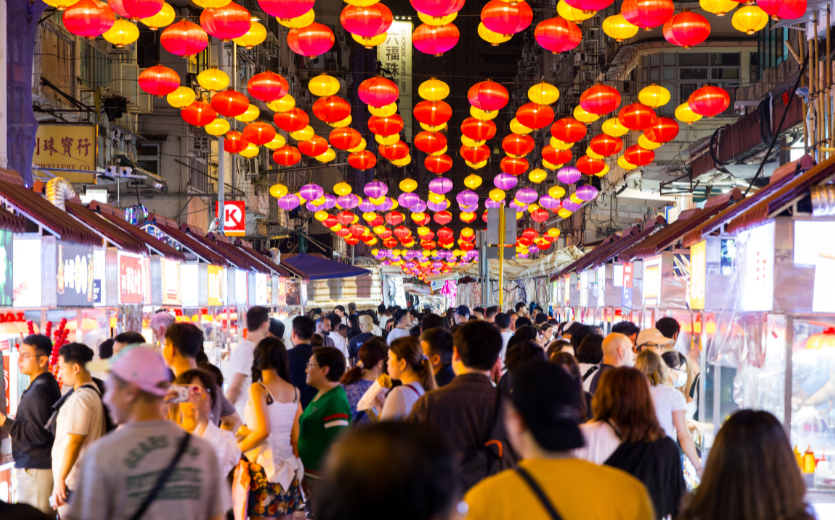
Temple Street is one of those places that feels unmistakably Hong Kong.
Neon.
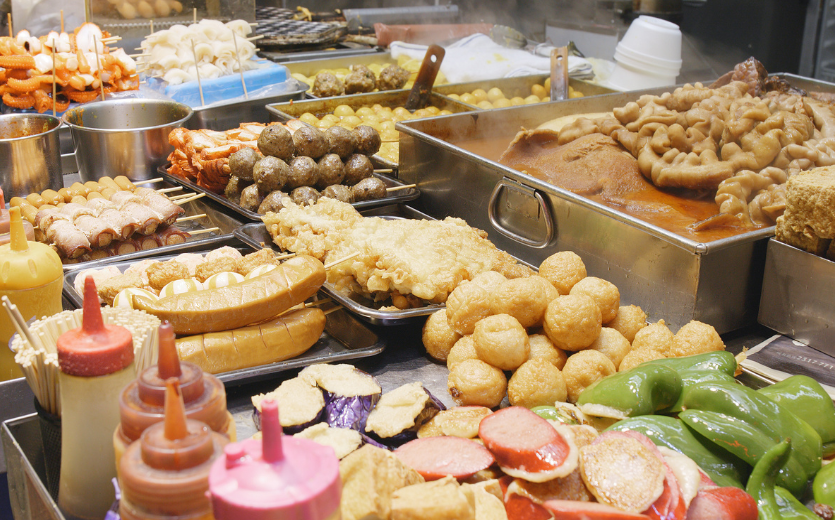
Steam rising from food stalls.
Plastic stools.
Fortune tellers sitting beneath small lamps.
The smell of claypot rice and seafood drifting into the street.
Voices overlapping.
People bargaining.
People eating.
People walking without really knowing where they are going next.
At first, it feels like the kind of night market you are supposed to experience with your eyes.
Then, somewhere between the stalls and the side streets, you hear something.
A voice.
Old-fashioned.
Emotional.
Perhaps slightly too loud.
You follow it.
And suddenly Temple Street becomes something else entirely.
The Rooms Above the Street
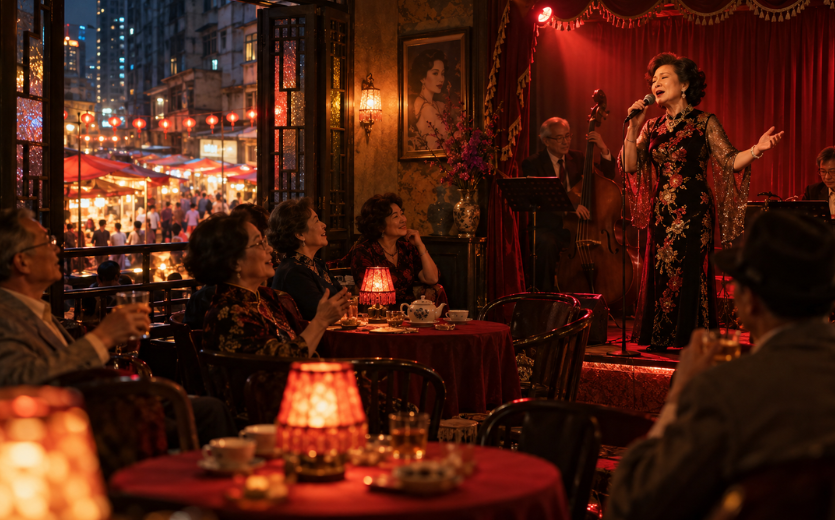
Hidden around Yau Ma Tei and Temple Street are remnants of an older Hong Kong nightlife tradition: small singing parlors where live performers still sing Cantonese songs for audiences gathered around simple tables.
Some of these venues grew out of the singalong houses and street-singing culture that flourished around Temple Street decades ago. One traditional singing parlour still promoted by the Hong Kong Tourism Board, Yim Yeung Tin Night Club, offers live performances in an intimate room with round tables, dark red curtains, colored lights and a stage where guests can even request songs or sing themselves.
It does not feel polished.
That is exactly the point.
The lights are low.
The décor can feel like it belongs to another decade.
An older singer takes the microphone.
Someone at a table recognizes the opening notes immediately.
A few people begin quietly singing along.
Then the whole room seems to lean into the song.
Before Karaoke Became Karaoke
Long before private karaoke rooms became one of Asia’s favorite forms of nightlife, Temple Street already had places where ordinary people gathered to listen, request songs and sometimes take the stage themselves.
The area has a long connection with Cantonese operatic singing and popular song. Temple Street’s performance culture once included multiple street groups, with singers and accompanists performing in the evening for local audiences. Research into the tradition notes that Temple Street became one of the last major urban places where this style of Cantonese operatic song survived.
Some of the old singing venues have disappeared.
Others moved indoors.
A few survived.
And inside them, a version of Hong Kong nightlife that once felt completely ordinary now feels almost secret.
Songs Everyone Seems to Know
The music may be Cantonese opera.
It may be an old Cantopop song.
It may be something from decades ago that younger visitors have never heard.
But watch the audience.
Someone knows it.
An older man taps the table.
A woman mouths the words.
Someone laughs when a familiar chorus begins.
A regular asks for a favorite song.
Temple Street has long hosted both Cantonese opera and Cantonese and Western popular songs, while reports from the neighborhood describe older performers continuing traditions that date back decades.
And suddenly the room starts to make sense.
This is not nostalgia created for tourists.
These songs belong to people.
They remind someone of being twenty.
Of an old girlfriend.
Of a movie.
Of the Hong Kong they grew up in.
Of parents who played the same songs at home.
Music does that.
A few notes, and forty years disappear.
It Feels Like a Hong Kong Movie
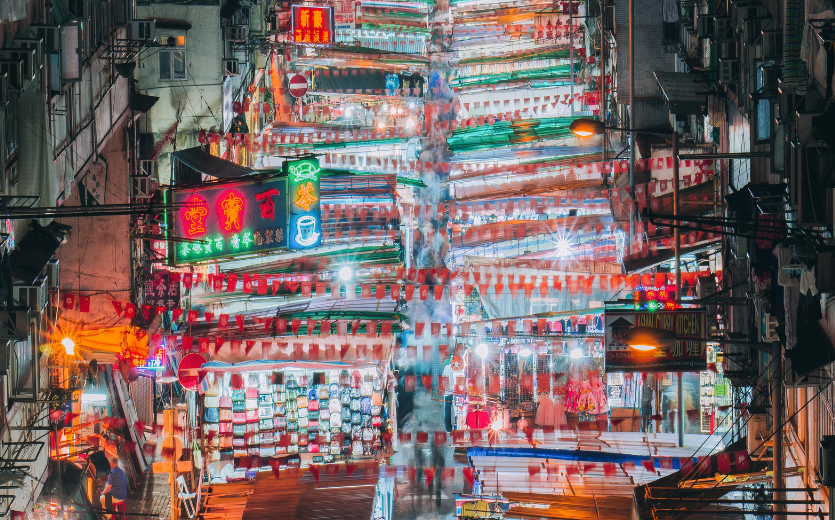
There is something undeniably cinematic about it.
The narrow staircase.
The slightly faded sign.
A room illuminated by red and yellow light.
An older singer holding the microphone with complete seriousness.
A glass sitting half-finished on the table.
The sound of Temple Street continuing somewhere outside.
It is easy to understand why the atmosphere brings to mind the Hong Kong cinema of the 1980s and 1990s.
Not because it has been designed to look retro.
Because it actually carries pieces of that era.
You half expect someone to walk through the door carrying an impossible love story.
But the most interesting thing is that nobody inside seems particularly concerned with creating atmosphere.
They are simply spending their evening.
The atmosphere happens by itself.
Sit Down and Stay for a Song
The best way to experience a place like this is not to enter as though you have discovered an attraction.
Enter quietly.
Sit down.
Order a drink or tea if the venue offers it.
Listen.
Watch how the room works.
See which songs make people look up.
Notice when someone begins singing along.
If song requests are part of the venue, ask how they work. Some traditional parlors allow customers to tip performers for a request, join them for a duet or even sing solo.
You do not need to understand every lyric.
Sometimes you do not need to understand any of them.
You can usually tell when a song is sad.
You can tell when it is romantic.
You can tell when everyone in the room has heard it a hundred times before.
That is enough.
Temple Street Is More Than a Market
It would be easy to visit Temple Street, eat something, buy something cheap, take photographs and leave.
You would still have a good evening.
But the neighborhood has always been more complicated than its market stalls.
For generations, Temple Street and Yau Ma Tei have been places of working-class entertainment: food stalls, fortune tellers, street performers, Cantonese opera and popular song all existing close together. Official and academic sources still describe Cantonese singing as an important part of the area’s cultural identity.
That is what makes these singing parlors interesting.
They are not separate from Temple Street.
They are part of the reason Temple Street became Temple Street.
A place where entertainment did not always require an expensive ticket.
Where people could eat, listen, sing, argue, laugh and spend the night among strangers.
Some Cities Keep Their Memories in Buildings
Hong Kong changes quickly.
Sometimes brutally quickly.
Buildings disappear.
Businesses close.
Neighborhoods reinvent themselves.
A place you remember can look completely different the next time you return.
But cities do not keep their memories only in architecture.
Sometimes they keep them in habits.
In food.
In language.
In the songs people still know by heart.
Inside a little singing parlour near Temple Street, an older performer raises the microphone.
The first notes begin.
Someone in the audience smiles before the first line is even finished.
Outside, Hong Kong keeps changing.
Inside, for the length of one song, it does not have to.

Experience a side of Hong Kong most visitors never see. Discover its unique after-dark culture with MASX! https://masxworld.com/hong-kong/