

Mel
Argentina Beyond the Flag: Passion, Rhythm and a History the World Rarely Sees
In This Article
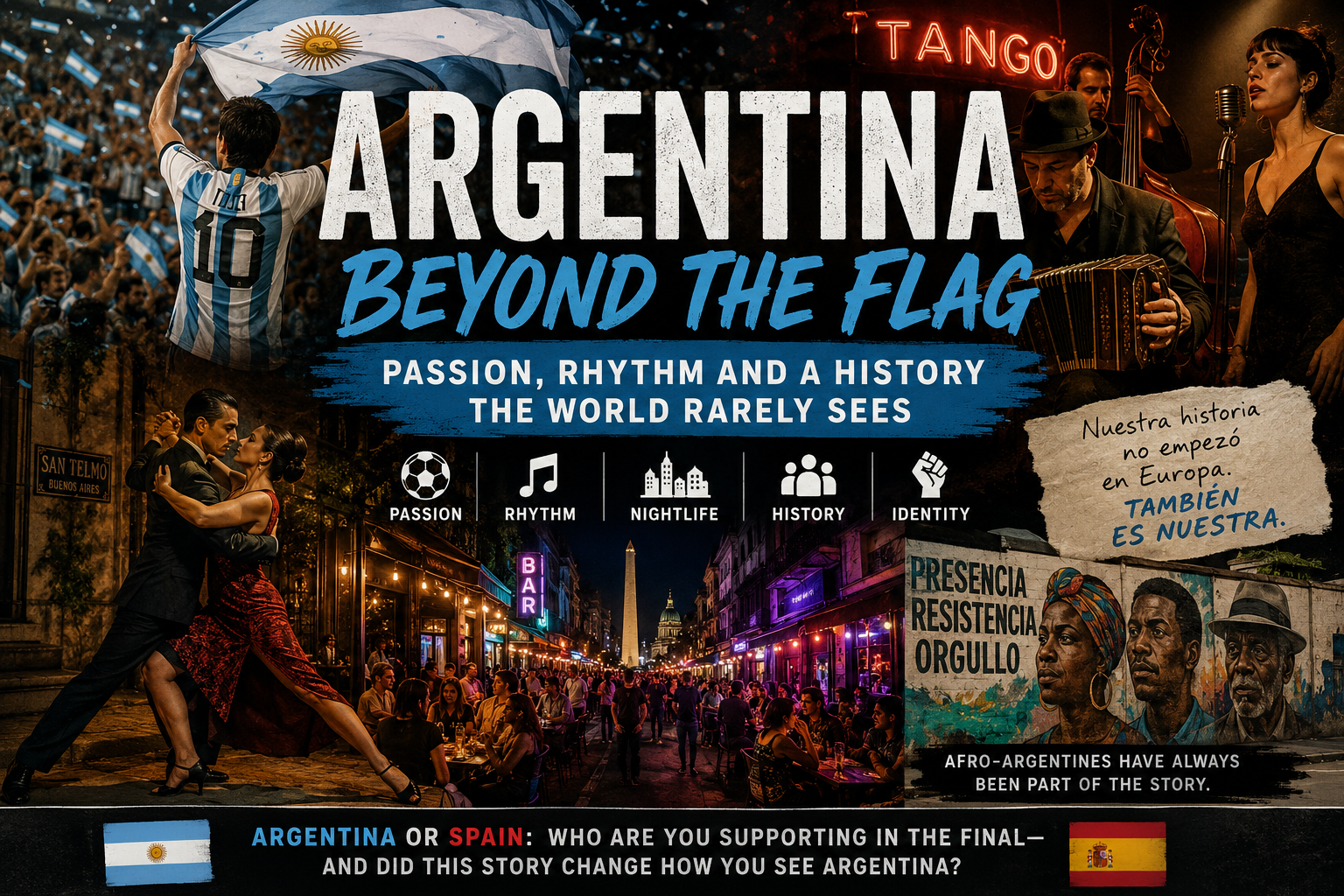
As Argentina prepares to face Spain in the 2026 World Cup Final, MASX looks beyond the famous blue-and-white shirta to explore the culture, music, nightlife and overlooked histories behind it.
On Sunday, July 19, Argentina will face Spain in the 2026 FIFA World Cup Final at New York New Jersey Stadium.
Argentina enters the match as the defending world and South American champion, while Spain arrives as the reigning European champion. It is a meeting between two of international football’s most celebrated nations.
For a few hours, Argentina will be represented by one flag, one shirt and the players standing on the field.
But no national team can tell the complete story of a country.
It cannot fully reveal the music created in its neighbourhoods, the communities that shaped its identity, the social traditions that continue into the early morning or the histories that were pushed outside the national picture.
The world recognizes Argentina.
But how deeply does it understand the culture behind the flag?
A Country That Expresses Emotion Publicly
Argentina is widely associated with passion, especially when football is involved.
Supporters sing through matches, public celebrations fill the streets and victories and defeats are experienced collectively. Football provides one of the country’s most visible stages for the expression of pride, hope and national identity.
That emotional intensity is not confined to stadiums.
It can also be found in music, political debate, literature, family gatherings and the long conversations that surround an asado.
Argentina does not always separate public culture from personal emotion.
It frequently turns emotion into performance, ritual and shared experience.
Tango: A Culture Created Through Encounter
Few cultural traditions are more closely associated with Argentina than tango.
However, tango is not exclusively Argentine. UNESCO recognizes it as a shared Argentine and Uruguayan tradition that developed among the urban working classes of Buenos Aires and Montevideo in the Río de la Plata region.
The communities involved included European immigrants, descendants of enslaved Africans and criollos. Their customs, beliefs and musical traditions came together and developed into a distinctive cultural expression involving music, dance and poetry.
That history matters because tango is often presented internationally as a polished, elegant performance.
Its foundations were much more complex.
Tango emerged from working-class urban life, migration and cultural exchange. It carried longing, memory, displacement and desire long before it became one of Argentina’s most recognizable cultural exports.
The refined performances seen today are part of tango’s story.
They are not the beginning of it.
Argentina Has More Than One Sound
Tango may be the rhythm most closely associated with Argentina, but the country’s musical culture extends far beyond it.
Argentine folk music varies significantly between regions. Rock nacional became an important form of social and cultural expression. Cumbia developed strong local audiences and styles, while electronic music, hip-hop, trap and other contemporary sounds continue to shape younger generations.
Buenos Aires can hold many of these musical worlds at once.
A traditional milonga, a live-rock venue, an electronic party and a cumbia night may all exist within the same city.
Argentina’s culture remains alive because it continues to evolve rather than remaining fixed within the image most familiar to tourists.
Buenos Aires After Dark
Buenos Aires is internationally recognized for its late-night social culture.
Dinner commonly begins later than it does in many other countries. Bars, restaurants, theatres, music venues and clubs contribute to a city that often remains active well beyond midnight.
Different neighbourhoods offer different experiences.
Palermo is known for busy restaurant, bar and nightlife areas. San Telmo remains closely associated with historic streets, performance and tango culture. Other neighbourhoods contribute their own combinations of music, food, art and social life.
The appeal of Buenos Aires after dark is not only the availability of entertainment.
It is the way the city allows evenings to unfold gradually.
Meals become conversations. Conversations move to another venue. Music begins late, and the end of the night is rarely treated as something that must be decided in advance.
But behind Argentina’s celebrated image as a culturally European Latin American nation lies a more difficult history involving race, visibility and belonging.
Black Argentines Did Not Simply Disappear
Many outside observers assume that Argentina has almost no Black population.
That assumption is connected to a national story that historically minimized the presence and contributions of Afro-Argentines.
Africans were brought to the region through the transatlantic slave trade during the colonial period. People of African descent later contributed to agriculture, economic life and Argentina’s independence struggles. According to a United Nations working group, much of that history was forgotten, while the trafficking and enslavement of Africans was largely erased from the country’s institutional memory.
For generations, the declining visibility of Afro-Argentines was commonly explained through war, disease and demographic change.
Those factors played a role, but UN experts warned that this narrative obscured the continued existence of Afro-Argentine communities. They connected that invisibility to a Eurocentric social model developed during the nineteenth and twentieth centuries and to Argentina’s self-image as a country of Europeans.
This does not mean that Argentina has no Afro-descendant population.
Argentina’s 2022 national census included nationwide questions allowing people to identify as Afro-descendant or as having Black or African ancestry, producing dedicated official data about the community.
The more accurate story is not that Black Argentines vanished.
It is that their presence and contribution were repeatedly made less visible within Argentina’s dominant national identity.
What the Football Team Can—and Cannot—Tell Us
Argentina’s national team does not appear to include players publicly identified as Afro-Argentine.
However, appearance alone cannot reliably establish a person’s ancestry or identity, and FIFA does not categorize players by race.
The team’s composition also does not, by itself, prove discrimination by current coaches, selectors or football authorities.
That distinction is important.
The stronger and more responsible question is not whether a particular squad is racist.
It is why Afro-Argentine history and identity remain unfamiliar to so much of the world—and sometimes to Argentina itself.
National teams are powerful symbols. They become one of the most visible ways countries present themselves internationally, even though no team could represent every community within a nation.
Argentina’s appearance on the world stage therefore creates an opportunity to look beyond the players and ask:
Who is included in the story Argentina tells about itself?
Who has historically been pushed outside that story?
And what becomes possible when those histories are finally recognized?
Celebration Does Not Require Silence
Argentina deserves to be celebrated.
Its football tradition is extraordinary. Its writers, musicians, artists and performers have influenced culture far beyond its borders. Buenos Aires remains one of Latin America’s most compelling cities, and tango has become part of humanity’s recognized cultural heritage.
But cultural appreciation does not require us to ignore contradiction.
A country can produce beautiful art while carrying unresolved inequality.
It can create culture through encounters between many communities and later minimize the contributions of some of them.
It can possess a powerful national identity while still asking who was allowed to stand at its centre.
These truths do not cancel Argentina’s achievements.
They help us understand the country more completely.
Beyond the Flag
When Argentina steps onto the field against Spain, the world will see the famous blue-and-white shirt.
MASX invites you to look further.
Listen to tango as the product of working-class communities and cultural exchange.
Experience the music and late-night energy of Buenos Aires.
Understand the emotion behind the football chants.
And recognize that Argentina’s history includes Afro-descendant communities whose presence and contributions were too often made invisible.
Argentina is more than football, tango and European architecture.
It is a country of extraordinary creativity, intense national pride and an ongoing conversation about race, memory and belonging.
The flag shows you the country. MASX reveals the culture.
Argentina or Spain: who are you supporting in the final—and did this story change how you see Argentina?
Follow MASX for cinematic travel inspirations, hidden gems, cultural facts, and so much more!
Instagram: https://www.instagram.com/masxworld
Facebook: https://www.facebook.com/share/1C5Ado1tV5/?mibextid=wwXIfr
TikTok: https://www.tiktok.com/@masxworld
YouTube: https://www.youtube.com/@masxworld