

Mel
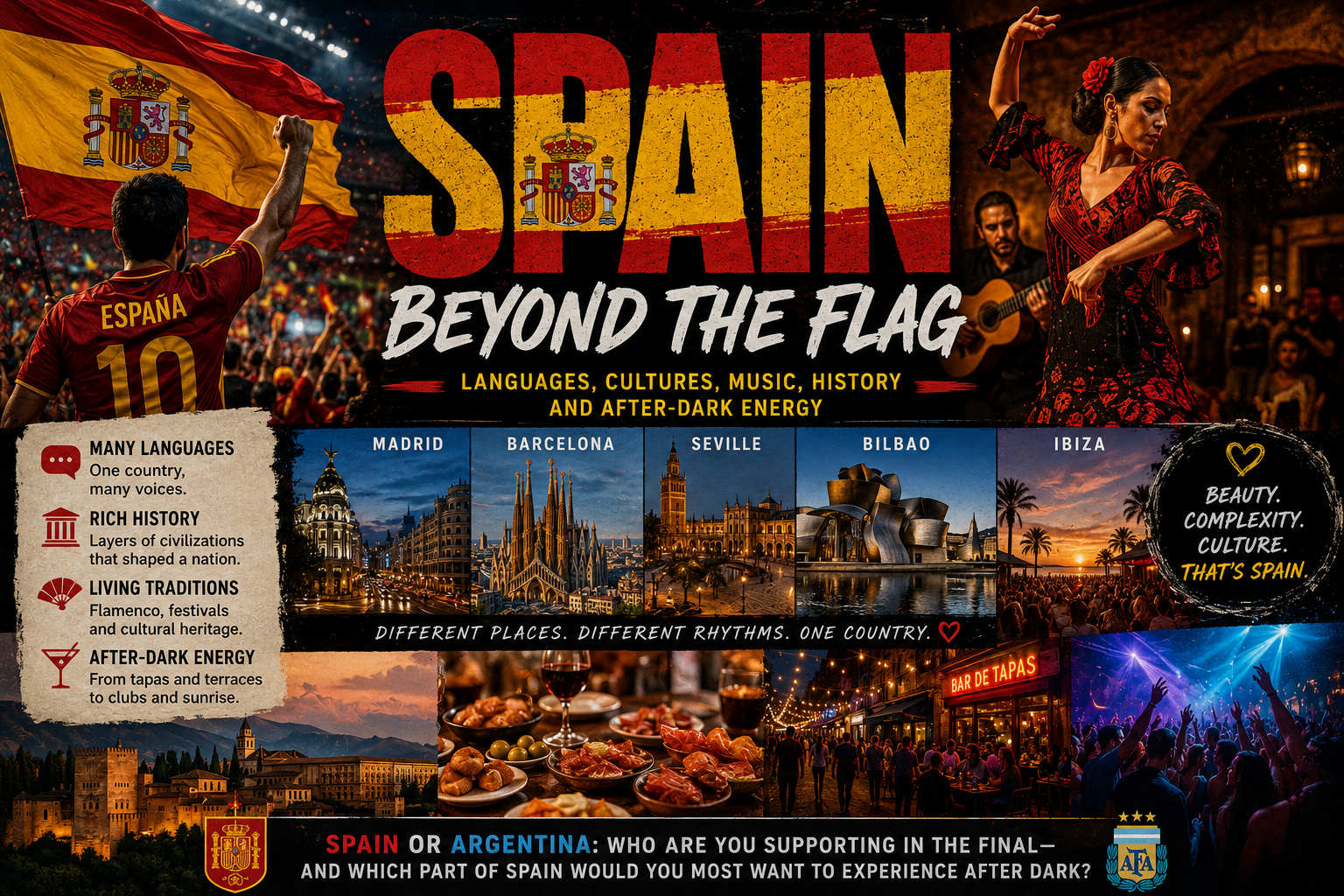
Spain Beyond the Flag: One Country, Many Identities and Nights That Refuse to End
In This Article
Before Spain faces Argentina in the 2026 World Cup Final, MASX looks beyond the red-and-yellow flag to explore the languages, cultures, music, history and after-dark energy behind it.
On Sunday, July 19, Spain will face Argentina in the 2026 FIFA World Cup Final at New York New Jersey Stadium.
Spain enters the match as the reigning European champion. Argentina arrives as the defending world and South American champion.
When Spain’s players walk onto the field, they will represent one country under one flag.
But the culture behind that flag is anything but singular.
Spain is shaped by distinct regions, languages, historical experiences and identities. People across the country do not always define Spanishness in the same way, and those differences are central to understanding modern Spain.
The world recognizes the flag.
But how much does it understand about the cultures behind it?
There Is More Than One Spain
Visitors often speak of “Spanish culture” as though it were one uniform experience.
Spain changes significantly as you move through it.
Madrid is the national capital, but it does not culturally define the entire country.
Catalonia has its own language, institutions and strong regional identity. The Basque Country has its own language and a distinctive historical and cultural tradition. Galicia has a co-official language and an Atlantic identity shaped by its geography and history.
Valencia, Andalusia, Asturias, the Canary Islands, the Balearic Islands and Spain’s other autonomous communities also maintain their own customs, celebrations, foods and cultural traditions.
Spain’s Constitution establishes Castilian Spanish as the state’s official language while recognizing that other Spanish languages may also be official within their respective autonomous communities. It describes Spain’s linguistic diversity as cultural heritage deserving special respect and protection.
Catalan, Basque, Galician and Valencian are among the languages officially used within particular autonomous communities.
Spain competes under one flag.
Behind it are many voices.
A Country Formed Through Historical Layers
The Iberian Peninsula has been shaped by a long succession of peoples, states and civilizations.
Roman rule, Visigothic kingdoms, Muslim-ruled territories, Jewish communities and Christian kingdoms all contributed to the peninsula’s history.
Those layers remain visible in Spain’s architecture, place names, languages, traditions and cities.
The Alhambra in Granada reflects the artistic and architectural achievements of Muslim-ruled al-Andalus. Córdoba, Toledo and Seville also preserve physical evidence of periods shaped by Islamic, Jewish and Christian communities, although their relationships were not always peaceful or equal.
Barcelona presents a different history through Catalan culture, maritime commerce, industry and modernist architecture. Galicia looks toward the Atlantic. The Basque Country carries a linguistic and cultural history unlike that of surrounding regions.
Spain is not culturally powerful because it possesses one uninterrupted identity.
Its culture was created through centuries of interaction, conflict, exchange and reinvention.
Flamenco Beyond the Tourist Image
Few artistic traditions are more closely associated with Spain than flamenco.
UNESCO defines flamenco as an artistic expression combining song, dance and musicianship—cante, baile and toque. Andalusia is its heartland, although it also has roots in Murcia and Extremadura.
Flamenco can express grief, joy, tragedy, celebration and fear. UNESCO inscribed it on the Representative List of the Intangible Cultural Heritage of Humanity in 2010.
Its development is strongly associated with Andalusia and with Gitano performers and communities, but its history is complex and has been shaped by multiple cultural influences.
For that reason, flamenco should not be reduced to a single, uncontested origin story.
Nor should it be treated simply as entertainment produced for visitors.
Flamenco is a living artistic tradition through which performers communicate memory, emotion and identity.
It may be one of Spain’s most recognizable symbols, but it belongs to a deeper cultural world than the tourist image usually reveals.
Spain Does Not Live Only in Tradition
Flamenco remains central to Spain’s cultural identity, but the country’s music continues to develop.
Madrid, Barcelona, Valencia, Seville, Bilbao and the Spanish islands support contemporary scenes involving electronic music, rock, hip-hop, pop, reggaeton, Latin music and experimental sounds.
Migration and international exchange have also contributed African, Latin American, Caribbean, Arab and other global influences to contemporary Spanish culture.
The result is not one national soundtrack.
Spain’s modern musical identity is a continuing conversation between local tradition, regional difference and global change.
A flamenco performance, an electronic festival, a neighbourhood celebration and a reggaeton club may all form part of Spain today.
Spain After Dark
Spain’s official tourism organization describes major cities and destinations including Madrid, Barcelona, Valencia, Bilbao, Granada and Ibiza as places with extensive restaurant, bar, live-music and club cultures that can continue until sunrise.
But Spain’s relationship with the night is broader than clubbing.
Evenings often develop through food and conversation.
Tapas encourage groups to share dishes, move between venues and treat eating as a social experience rather than a hurried stop before something else.
Terraces and public squares remain active late into the evening. Bars and restaurants often serve as social spaces for multiple generations rather than being reserved exclusively for young nightlife crowds.
Madrid offers neighbourhood taverns, live music, cocktail bars and major clubs.
Barcelona combines Mediterranean urban life with design, art and electronic culture.
Seville is closely associated with Andalusian traditions and flamenco. Valencia combines coastal life with major public festivals. Bilbao offers a northern experience shaped by Basque culture, food and contemporary arts.
Each city reveals a different Spain after dark.
Ibiza Beyond the Superclubs
Ibiza became internationally famous through electronic music and large-scale clubs.
That global reputation is deserved, but it is incomplete.
The island also contains historic communities, beaches, restaurants, smaller music venues and a sunset culture that forms an important part of its international identity.
The Ibiza experience is therefore not limited to a single club or style of music.
Its appeal lies partly in the transition from sea and sunlight to sunset, dinner, music and sunrise.
This is where Spain connects strongly with the MASX philosophy.
After-dark culture is not defined only by venues.
It is created through the relationship between music, food, geography, local traditions and human connection.
Festivals as Living Heritage
Spain has numerous traditions recognized by UNESCO as intangible cultural heritage.
They include flamenco, Catalonia’s human towers, Valencia’s Fallas festival, Córdoba’s patio festival, Mediterranean food traditions and Asturian cider culture.
These traditions should not be viewed only as attractions.
They are ways communities preserve knowledge, express local identity and gather across generations.
Human towers require coordination and trust. The Fallas transform Valencia through monumental artistic constructions, public celebration and fire. Córdoba’s patios connect private homes, neighbourhood life and seasonal ritual.
To understand Spain, visitors must look beyond landmarks.
They must also observe how people occupy streets, protect traditions and turn public space into shared cultural experience.
The Difficult Histories Behind the Beauty
Spain is easy to romanticize.
Its beaches, architecture, cuisine, art, festivals and nightlife have made it one of the world’s most recognizable destinations.
But the country’s history also includes empire, colonial rule, religious persecution, civil war, dictatorship and continuing debates over regional autonomy and independence.
Those subjects are too large and complex to be reduced to a few lines.
But they should not be ignored.
Modern Spanish identity developed through both cultural achievement and political conflict.
Recognizing that complexity does not make Spain less appealing.
It allows travellers to understand why questions of language, memory, nationalism and regional identity remain meaningful today.
Celebration becomes more valuable when it leaves room for history.
What the National Team Represents
Spain’s national football team provides a highly visible moment of unity.
Players from different parts of the country compete under one flag, and millions of supporters temporarily share a common national experience.
But football has also reflected Spain’s regional complexity.
Relationships with the national team can differ across communities, especially where regional identity and Spanish nationalism have historically existed in tension.
The team therefore represents something both simple and complicated.
For the duration of a match, one shirt creates unity.
Behind that shirt, Spain remains culturally and politically diverse.
That does not diminish the country.
It is one of the most important things to understand about it.
Beyond the Flag
When Spain faces Argentina in the World Cup Final, the world will see a red-and-yellow flag and a team attempting to create another historic sporting moment.
MASX invites you to look further.
Listen to flamenco as an emotional and evolving cultural tradition.
Hear the different languages spoken across the country.
Move from Madrid’s late-night streets to Barcelona’s creative energy, Andalusia’s musical traditions and an Ibiza sunrise.
Recognize the Roman, Islamic, Jewish, Christian, Gitano, regional and global influences that contributed to the Spain that exists today.
Spain is not one culture waiting to be summarized.
It is a country made more compelling by the many identities, histories and rhythms within it.
The flag shows you the country. MASX reveals the culture.
Spain or Argentina: who are you supporting in the final—and which part of Spain would you most want to experience after dark?
Follow MASX for cinematic travel inspirations, hidden gems, cultural facts, and so much more!
Instagram: https://www.instagram.com/masxworld
Facebook: https://www.facebook.com/share/1C5Ado1tV5/?mibextid=wwXIfr
TikTok: https://www.tiktok.com/@masxworld
YouTube: https://www.youtube.com/@masxworld