
Mel
Shichahai at Night: Where Old Beijing Still Feels Alive
In This Article
Beijing is a city of scale.
Wide avenues.
Massive squares.
Imperial gates.
Palaces built to impress.
Everything can feel grand, formal, and larger than life.
But some of Beijing’s most memorable moments happen in places that feel much smaller.
Narrow lanes.
Low grey-brick walls.
Courtyards hidden behind wooden doors.
Bicycles leaning against old buildings.
A light left on above a tiny neighborhood shop.
This is the world of Beijing’s hutongs.
And around Shichahai, that world becomes particularly interesting after dark.
When the Hutongs Slow Down
During the day, the Shichahai area can feel busy.
Visitors walk between the lakes.
Rickshaws pass through the lanes.
People stop for photos.
Cafés, shops, restaurants, and historic courtyards pull attention in every direction.
But evening changes the rhythm.
As daylight fades, the hutongs begin to feel less like somewhere to explore and more like somewhere people actually live.
You hear bicycles passing behind you.
A scooter disappears around a narrow corner.
Someone opens a courtyard door and calls inside.
A family walks home carrying groceries.
Older residents sit outside talking.
A small restaurant begins filling with people finishing work.
The city becomes quieter, but not empty.
There is still movement everywhere.
It is simply more human.
A Different Kind of Beijing Night
Beijing nightlife is often imagined through bright shopping districts, rooftop bars, restaurants, and huge entertainment areas.
Shichahai offers something very different.
Here, the night feels closer to the ground.
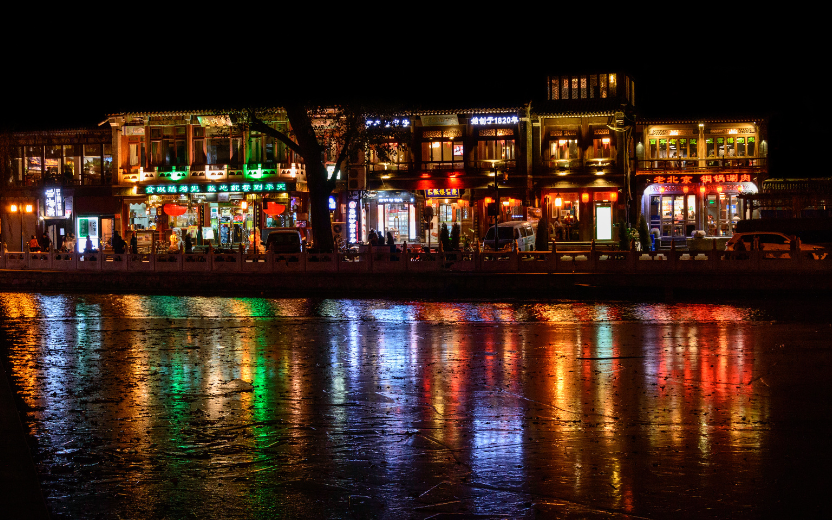
Lights from restaurants spill onto stone paths.
Small groups gather outside neighborhood eateries.
The smell of grilled meat, noodles, tea, and warm snacks moves through the alleys.
Friends walk beside the water without rushing.
Couples sit near the lakes.
Families bring children out for an evening stroll.
Some people exercise.
Some simply sit.
Others seem to be doing nothing at all.
And that is part of the pleasure.
You do not need a complicated plan here.
Walk slowly.
Turn down a lane that looks interesting.
Stop when you smell something good.
Look inside a small restaurant.
Sit beside the lake for a while.
Let the neighborhood decide what happens next.
Between the Hutongs and the Water
Shichahai is unusual because the hutongs open onto a landscape of lakes.
Qianhai.
Houhai.
Xihai.
The water gives the neighborhood space to breathe.
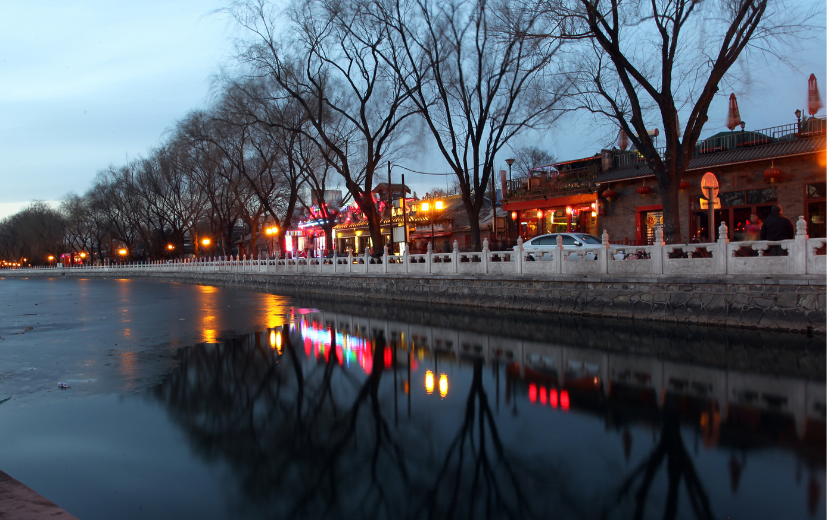
At night, reflections from bridges, restaurants, trees, and nearby buildings stretch across the surface.
People walk the paths along the lakeshore.
Some talk quietly.
Some take photos.
Some carry drinks or snacks.
And some seem to come simply because this is where they like to spend the evening.
The atmosphere can change quickly.
One moment you are beside the water with open views and lights reflected across the lake.
A few minutes later, you turn into a narrow hutong where the sky almost disappears between roofs and walls.
That contrast is part of Shichahai’s charm.
Open water.
Tight lanes.
Busy restaurants.
Quiet doorways.
Visitors.
Residents.
Old Beijing and modern Beijing, moving through the same night.
What Locals Are Doing
The most interesting thing about Shichahai at night is not necessarily what travelers come here to see.
It is what everyone else is doing.
People are having dinner after work.
Grandparents are walking with grandchildren.
Friends are catching up.
Someone is cycling home.
Someone is buying something from a small shop.
Neighbors stop to talk.
Older men sit together outside.
Young people take photos near the water.
A couple walks without saying much.
The scenes are ordinary.
And because they are ordinary, they feel meaningful.
Travel often encourages us to search for the extraordinary.
The biggest landmark.
The most famous restaurant.
The perfect photograph.
But sometimes, understanding a place means watching people live normally.
Shichahai is good for that.
The Warmth of Old Beijing
Hutongs are often described as historic.
And of course, they are.
But if you only think of them as heritage, you miss something.
They are also social spaces.
For generations, life in these narrow neighborhoods has happened close to other people.
Doors are near each other.
Courtyards are shared.
Neighbors see each other often.
People sit outside.
Conversations spill into the lane.
That closeness still shapes the atmosphere.
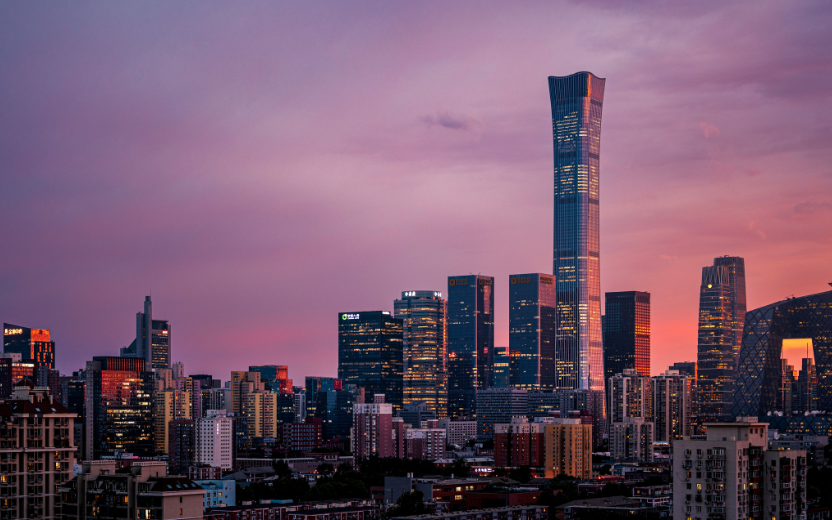
Even as Beijing becomes taller, faster, and more modern, the hutongs preserve a different relationship with the city.
Here, Beijing can feel less anonymous.
Less monumental.
More personal.
You begin noticing faces instead of buildings.
Voices instead of traffic.
Small gestures instead of grand sights.
How to Enjoy Shichahai at Night
Do not rush through it.
That is probably the most important advice.
Come around late afternoon if you can.
Walk while there is still some daylight.
See the grey walls, rooftops, courtyards, and lake paths before the lights come on.
Then stay.
Let the neighborhood change around you.
Eat somewhere small.
Try a local snack.
Walk beside Houhai.
Turn into the quieter lanes away from the busiest waterfront.
Sit when you feel like sitting.
Watch people.
Listen.
There is no need to turn every moment into an activity.
Shichahai rewards people who slow down.
Beijing Feels Different Here
Beijing can sometimes feel intimidating.
It is enormous.
Historic.
Political.
Fast-moving.
Full of places that carry enormous cultural weight.
But in the hutongs around Shichahai, that scale shrinks.
The city becomes a conversation outside a restaurant.
A bicycle passing beneath a streetlight.
A family walking beside the water.
A bowl of something warm after dark.
A neighbor calling to someone across the lane.
And suddenly, Beijing feels less like a capital city and more like a neighborhood.
Perhaps that is what makes Shichahai worth experiencing at night.
You are not only looking at old Beijing.
For a few hours, you are walking through a version of Beijing that still knows how to slow down.
A city where people still meet outside.
Where evenings still belong to conversation.
Where history is not locked behind museum walls.
It is living quietly in the lanes around you.
Want to experience China beyond the usual sights? Discover your China Xperience with MASX. https://masxworld.com/china/