
Mel
The Battlefield Became Music: How Trinidad Turned Steel, Street Rivalry and Violence into a National Sound
In This Article
The history of the Trinidad steelpan is often told as a triumphant story of invention: discarded oil drums transformed into tuned instruments, poor communities creating something entirely new, and a local sound eventually becoming a national symbol. All of that is true, but it is only part of the story.
The steelband movement also emerged from a world of territorial rivalry, social exclusion, police hostility, street violence and fierce neighbourhood loyalty.
To understand the power of the steelpan, it is necessary to understand that it was not born in a concert hall.
It was forged in the streets.
More Than a Band
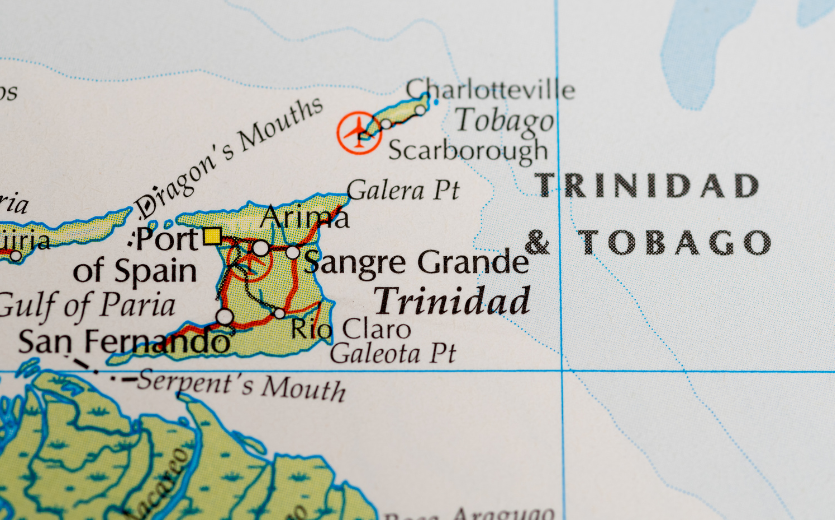
In the middle decades of the twentieth century, steelbands were closely tied to working-class communities in and around Port of Spain.
A band was more than a group of musicians.
It represented a neighbourhood, a social circle, a territory and, often, a deeply felt collective identity.
Young men gathered around these bands not simply to make music, but to belong.
In a society where many of them were dismissed as hooligans, badjohns or troublemakers, the steelband offered recognition, brotherhood and status.
That sense of identity could become dangerous.
Rivalries between bands sometimes developed into genuine street warfare. Historical records from Trinidad and Tobago describe violent confrontations involving stones, bottles, knives, razors, cutlasses and other weapons.
The clashes were not symbolic.
People were seriously injured, and some encounters became infamous.
One of the best-known confrontations took place during Carnival in 1950 between Invaders and Tokyo, a clash that entered steelband folklore and was later remembered in calypso.
It is important not to romanticise this period.
The idea that steelbands simply “fought with pans instead of guns” makes for a striking line, but it is not historically accurate.
The violence was real, and so were the weapons.
The more powerful truth is that, over time, the movement developed another way for bands to prove superiority.
Musical rivalry began to replace at least some of the territorial violence.
The fight did not disappear overnight.
But the battlefield slowly changed.

Before the Pan, There Was Resistance
The roots of the instrument itself go back to an even earlier struggle over cultural expression.
Colonial authorities had repeatedly attempted to restrict African-derived drumming and Carnival traditions.
In response, Trinidadians developed new forms of percussion, including tamboo bamboo, in which different lengths of bamboo were struck against the ground or against one another.
When bamboo proved fragile and limited, musicians increasingly experimented with metal objects: biscuit tins, brake drums, dustbins, containers and eventually oil drums.
Then came the crucial discovery.
Metal could produce not only rhythm but pitch.
By hammering, shaping and tuning different sections of a steel surface, musicians discovered that they could create distinct musical notes.
What had once been industrial waste could now carry melody.
Through experimentation, competition and relentless refinement, the steelpan emerged as a new instrument.
It was not imported from Europe, nor copied from an existing orchestral tradition.
It was developed in Trinidad through the ingenuity of local musicians and craftsmen.
When a Band Carried a Neighbourhood
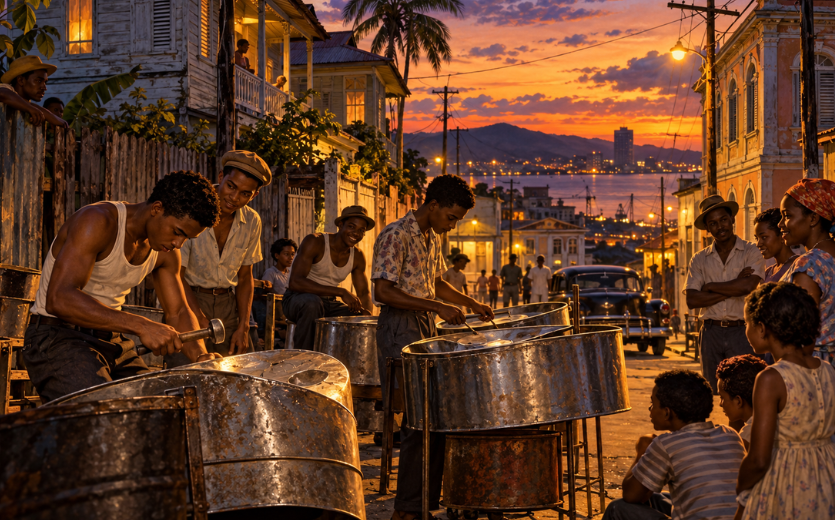
The early steelbands quickly became associated with particular communities.
Names such as Invaders, Tokyo, Casablanca, All Stars, Desperadoes and Renegades carried enormous weight.
Supporting a band could be almost tribal.
A band’s sound, reputation and courage reflected on the neighbourhood itself.
Crossing into another band’s territory could be provocative, and meeting a rival group on the road during Carnival could lead to confrontation.
This was a world in which music, masculinity, community pride and street power overlapped.
Yet even during the most turbulent years, something else was happening.
Steelpan technology was improving at remarkable speed.
Tuners were discovering how to create more notes and better tone.
Players were becoming more technically accomplished.
Arrangers were pushing bands into increasingly complex music.
The question was no longer only which band controlled a street or commanded fear.
It was becoming:
Which band sounded better?
When Rivalry Became Musicianship
That shift was profound.
Rivalry could now be expressed through tuning, arranging, precision and musical daring.
A band could defeat another band not by chasing it out of a neighbourhood but by outplaying it.
Pride could be defended with melody and rhythm.
Status could be earned through innovation.
Competition remained intense, but it could increasingly be channelled into performance.
One of the great traditions that grew from this competitive culture was the “bomb tune.”
Steelbands would secretly prepare unexpected arrangements, often of classical or sophisticated popular music, and unveil them during Carnival.
The surprise itself was part of the victory.
A band could shock the crowd and embarrass its rivals simply by producing something nobody expected.
In that sense, musical invention became a form of attack.
The bomb was no longer explosive.
The bomb was the arrangement.
From Street Conflict to Organisation
The steelband movement also began to organise itself more formally.
By 1950, leaders were attempting to reduce violence and bring bands into a more structured national organisation.
This was an important turning point.
Bands that had often regarded one another as enemies were now being drawn into meetings, negotiations and collective representation.
The same communities that had produced territorial conflict were beginning to build institutions.
Perhaps the clearest symbol of this transformation came in 1951 with the Trinidad All Steel Percussion Orchestra, better known as TASPO.
Outstanding players from different steelbands were selected to perform together and travel to Britain for the Festival of Britain.
The symbolism was extraordinary.
Men from a movement that had been treated by sections of respectable society as delinquent were now representing Trinidad abroad as musicians and cultural ambassadors.
The social reversal is difficult to overstate.
The panman had once been viewed with suspicion.
Families could discourage their children from associating with steelbands.
Police and authorities often treated bands as potential sources of disorder.
Yet within a relatively short period, these same musicians were demonstrating the sophistication of the steelpan on an international stage.
Panorama Changed the Battlefield
The next major transformation came with Panorama, first held in 1963.
Panorama gave steelband rivalry a national arena.
The competitive instinct remained, but now it had structure, rules and a stage.
Bands could represent their communities with the same fierce pride as before, but supremacy could be pursued through music.
This did not make the rivalry gentle.
Panorama became, and remains, intensely competitive.
Bands spend enormous amounts of time preparing a single arrangement.
Tuners work to refine the sound of the instruments.
Arrangers construct intricate musical architecture.
Players rehearse for weeks and months to achieve precision.
Entire communities invest emotionally in the result.
The language of battle never entirely disappeared because the emotional intensity never disappeared.
Bands still “come to fight.”
They still speak of defending their name and representing their yard.
Supporters still argue passionately about who played best.
But the meaning of the fight changed.
The weapon became musicianship.
The Pan Yard Became Something Else
That transformation is one of the most remarkable aspects of the steelpan story.
Trinidad did not simply invent a new instrument.
It created a cultural system around that instrument that could absorb rivalry, pride and competitive aggression and redirect them toward artistic achievement.
The steelpan is therefore much more than an example of Caribbean musical creativity.
It is also a story about social transformation.
Young men who were marginalised by society became innovators, tuners, arrangers and virtuoso performers.
Neighbourhood groups that were once associated with street disorder developed into respected cultural institutions.
Industrial scrap became an orchestra.
None of this means the history should be cleaned up.
The steelband wars were violent.
People were hurt.
Rivalries could be brutal.
Those facts matter because they make the later transformation more significant, not less.
The greatness of the story lies in the fact that the movement did not remain trapped in that violence.
Instead, competition found a new language.
A band could still carry the pride of an entire neighbourhood, but now that pride could be expressed through tone, harmony, rhythm and arrangement.
The pan yard became a workshop and a conservatory.
The tuner became an engineer.
The arranger became a strategist.
The players became an orchestra.
Steel was still being struck.
But now it was being struck to make music.
The Battlefield Became Music
That may be the most powerful way to understand the history of the steelpan.
Trinidad did not simply take metal and turn it into an instrument.
It took something harder to transform: rivalry, exclusion, anger and street conflict, and redirected part of that energy into cultural creation.
The weapons of the early steelband wars were real.
So was the violence.
But over time, Trinidad found another battlefield.
And on that battlefield, the fight was for the sweetest tone, the strongest arrangement, the most powerful performance and the sound that could bring an entire crowd to its feet.
The battlefield became music.
And the steelpan became one of Trinidad and Tobago’s greatest gifts to the world.
Ready to feel the energy, history, and community behind Trinidad’s national instrument? Experience the steelpan with MASX and hear the story for yourself!