


MASX WORLD
Travel Without Borders: How Real-Time Translation Is Changing the Way We Explore The World
Imagine landing in Tokyo, Seoul, or Hanoi—without speaking a word of Japanese, Korean, or Vietnamese—and still ordering food like a local, navigating train stations with confidence, and chatting with street vendors like old friends.
Thanks to real-time translation technology, that vision is no longer a fantasy—it’s the new normal for travelers in 2025.
While AI and automation are transforming nearly every industry, real-time language translation is quietly revolutionizing travel, especially in Asia, where language diversity can be a major barrier for international tourists.
Here’s how this tech is unlocking immersive, borderless travel experiences across Asia and beyond.
1. Speak Like a Local (Without Speaking the Language)
The days of fumbling through phrasebooks or awkwardly pointing at signs are fading fast. Apps like Google Translate, iTranslate, and Papago now allow travelers to:
- Speak into their phones and instantly get translated audio
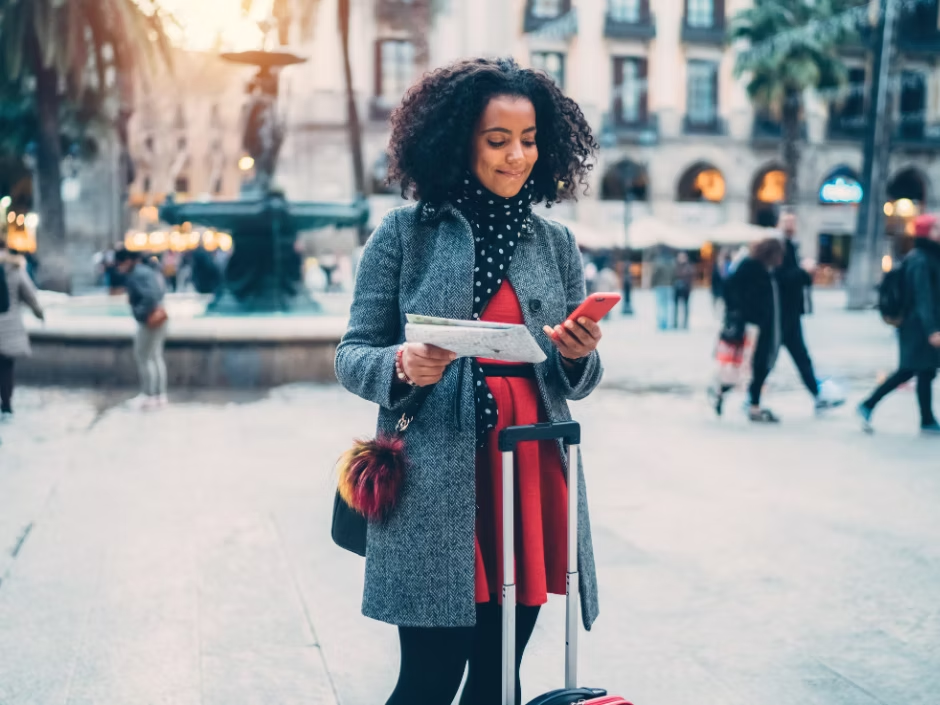
- Use live camera mode to translate street signs, menus, and maps in real time
- Engage in full conversations with locals using voice-to-voice interpretation
In places like Japan or South Korea, where English signage can be limited, this tech becomes a lifesaver—and a confidence booster.
2. Say Goodbye to the Language Barrier Anxiety
Many travelers skip destinations out of fear:“What if I can’t communicate? What if I get lost?”
Real-time translation tools erase that fear.
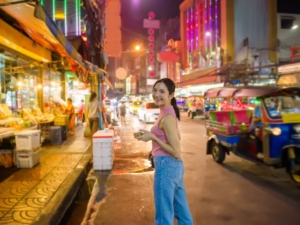
You can now hop on a train in Tokyo, shop at a floating market in Bangkok, or join a cooking class in rural Vietnam without knowing the local language—and still feel connected, understood, and welcome.
It’s like having a multilingual guide in your pocket 24/7.
3. Unlock Authentic Local Experiences
Want to go beyond tourist traps and dive into real local culture?Language is the gateway.
With real-time translation, you can:
- Chat with a temple caretaker in Kyoto about ancient rituals
- Learn the story behind your street food in Taipei
- Ask directions in a mountain village in Northern Thailand
- Join a family-run tea ceremony in rural China
These moments were once reserved for polyglots or tour guides. Now, anyone can bridge the language gap and form genuine human connections.
4. Why Experts Say This Is Bigger Than AI
Kwek Leng Beng, executive chairman of Banyan Tree Holdings, recently said:
“It’s not AGI or humanoid robots that will transform travel first—it’s real-time language translation.”
Why? Because it directly enhances your travel experience, improves accessibility, and empowers solo, independent travel even in remote, rural regions.
While robots and AI assistants are futuristic buzzwords, translation tech is already here—and it’s working.
5. Perfect Timing for Asia’s Travel Boom
With Asia-Pacific leading global travel growth in 2025, the region is experiencing a massive wave of new tourists from the West—and from within Asia itself.
But this boom comes with linguistic challenges.From Mandarin and Thai to Korean, Khmer, Tagalog, and Hindi, travelers encounter a kaleidoscope of languages in a single region.
Real-time translation is becoming the glue that holds these diverse travel experiences together, offering freedom, flexibility, and deeper cultural immersion.
Travel Is Now Truly Borderless
With a smartphone and a good data plan, language is no longer a limitation—it’s an opportunity.Real-time translation doesn’t just help you get around—it helps you belong.
So, next time you’re hesitant about traveling somewhere “too foreign,” remember:The future of travel speaks every language—and now, so can you.
Let’s start planning your next travel!
LIVE ULTIMATE XPERIENCES (L.U.X.)!
Go visit our website to find a perfect destination for your next vacation! MASX WORLD