


MASX WORLD
Bhutan’s Human Traffic Lights: Why This Himalayan Kingdom Chose People Over Automation
In most countries around the world, traffic lights are a basic part of daily life. Red means stop. Green means go. It is a universal language of modern transportation.
But in Bhutan, things are different.
The Himalayan kingdom once installed electronic traffic lights in its capital city, Thimphu. However, the experiment was short-lived. Residents felt the lights were too impersonal and robotic. Instead of keeping the automated system, Bhutan chose to return to something more human: trained traffic police officers directing vehicles by hand.
This decision reflects more than traffic management. It reveals something deeper about Bhutan’s culture, values, and philosophy.

The Brief Experiment with Traffic Lights
In the late 1990s, Bhutan introduced electronic traffic lights at a busy intersection in Thimphu. At the time, many countries had already fully adopted automated systems to manage growing urban traffic.
But the response in Bhutan was unexpected.
Locals felt that the mechanical signals did not fit the spirit of their city. The lights were seen as cold and disconnected from the human-centered rhythm of daily life. Within a short period, the government removed the traffic lights and reinstated human traffic officers.
Today, Thimphu remains one of the only capital cities in the world without standard traffic signals.
How Traffic Works in Bhutan
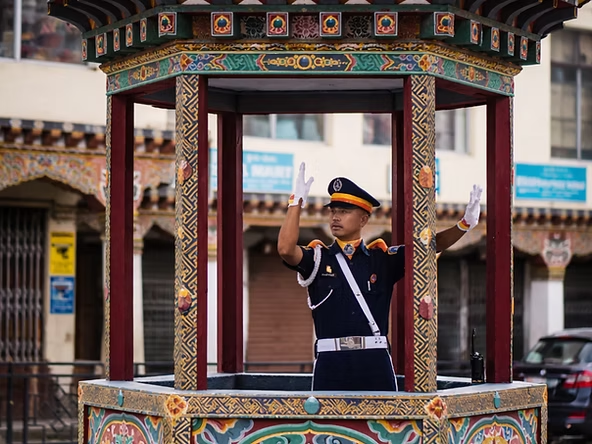
Instead of electronic lights, uniformed traffic police stand at key intersections, often inside small decorative booths, directing vehicles with precise hand movements.
Their gestures are calm, deliberate, and almost graceful. Drivers respond attentively, maintaining a cooperative flow. Visitors often describe the experience as surprisingly orderly and peaceful.
Traffic does not feel chaotic. It feels guided.
This system works partly because Bhutan’s population is relatively small and urban congestion is limited compared to larger global cities. But it also works because of cultural values rooted in patience, respect, and social awareness.
Why Bhutan Prefers a Human Touch
Bhutan is internationally known for its development philosophy called Gross National Happiness. Rather than measuring success purely through economic growth, the country prioritizes well-being, cultural preservation, environmental protection, and good governance.
The decision to remove traffic lights aligns with that philosophy.
In Bhutan:
- Human interaction is valued over automation.
- Community connection matters.
- Mindfulness is encouraged in daily life.
A traffic officer making eye contact with drivers creates a moment of shared responsibility. It reinforces attentiveness rather than passive obedience to a machine.
This approach reflects Bhutan’s broader belief that modernization should not erase human connection.
What Travelers Notice
For visitors, the absence of traffic lights becomes one of Bhutan’s most memorable details.
Travelers often appreciate:
- The calm pace of city life.
- The unique sight of hand-directed intersections.
- The blend of tradition and modern governance.
In a world increasingly driven by screens and automation, Bhutan’s roads feel personal.
The experience offers a subtle reminder that progress does not have to mean uniformity.
Is Bhutan Anti-Technology?
Not at all.
Bhutan has embraced technology in many areas, including telecommunications, education, and sustainable development. The country simply adopts modernization selectively, ensuring it aligns with cultural identity and social harmony.
The removal of traffic lights was not about rejecting progress. It was about choosing a system that better suited local values.
A Symbol of Cultural Confidence
Bhutan’s traffic system may seem like a small detail, but it represents something larger.
It shows that a nation can participate in the modern world while still protecting its character. It demonstrates confidence in cultural identity. And it highlights the importance of human presence in everyday life.
In Bhutan, even an intersection reflects philosophy.
Bhutan’s choice to remove electronic traffic lights in favor of human traffic officers is more than a curious travel fact. It is a window into a society that values balance, mindfulness, and community.
For travelers seeking destinations that feel different in meaningful ways, Bhutan offers more than landscapes and monasteries. It offers a perspective.
Sometimes, slowing down and choosing people over machines can be a powerful statement.
If you are interested in the world’s unwritten rules, please watch our Foreign Fine Print series on Youtube!
Foreign Fine Print is a MASX World original series exploring the unwritten rules behind the world’s most fascinating cultures.
Not etiquette guides. Not travel hacks. But the invisible systems that shape how people live together.
🕒 New episodes every Tuesday at 9AM EST
🌏 Subscribe & turn on notifications — because every culture has fine print, and we help you read it before you go.